Welcome to the Lucky Penny Jar universe—beginning with the 12-book Penny Wiggle collection. Every child experiences “wiggles”—those tugging sensations of worry, loss, curiosity, or needing comfort. Join Penny as she discovers that big feelings are okay, and that young readers hold the strength inside their own hearts to handle them.
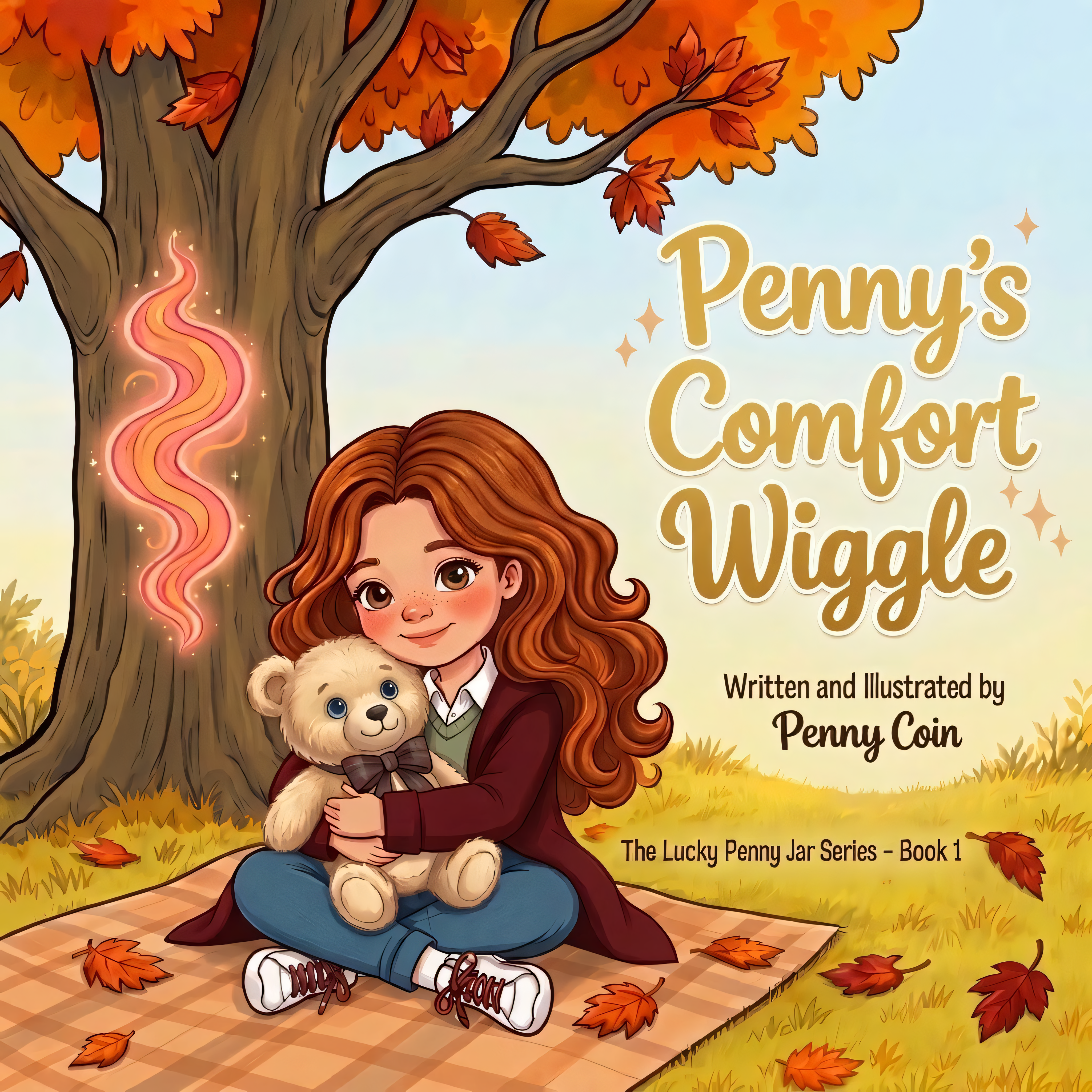
Book 1: Penny’s Comfort Wiggle — Collection 1 of The Lucky Penny Jar Series
Why a simple, gentle word like “wiggle” opens the door to real connection in a noisy digital world.
Children today are surrounded by digital noise, quick answers, and online advice that isn’t meant for young hearts. Talking about feelings has become harder for families, not easier. Many children turn to screens, friends, or older siblings who are also learning from the same online world—a world that cannot replace a parent’s voice, presence, or guidance.
The Penny Wiggle books were created to give children a safe, simple way to begin these conversations. Instead of saying “I’m mad,” or “I’m scared,” a child can say, “I have a wiggle today.” This gentle word lowers the pressure and opens the door for connection.
A wiggle is any feeling that doesn’t sit quite right—a tug, a swirl, a flutter, a tightness. Something real, even if they don’t yet have the words for it. Over time, your child may say, “I have a Comfort Wiggle today,” and you will both understand what that means because you learned it together.
Children need our wisdom more than ever, especially in a world that often pulls them toward quick answers instead of real conversations. Sharing stories gives you a chance to offer that wisdom in a way your child can feel—not just hear.
Most of all, these books are meant to bring you and your child closer. Reading together creates a bond that nothing else can replace. Penny is written as a real child, with real feelings, so your child can see themselves in her experiences—and you may even recognize a few wiggles from your own childhood, too.
Thank you for taking this time with your child. Every shared story strengthens the connection they will carry with them for life.
Whether you are 6 years old or 40 years old, life is full of mornings when you wake up with a restless feeling you can’t quite shake.
Like most children, Penny often goes through her day with something small bothering her yesterday—or simmering quietly in the back of her mind over the past few weeks. She goes to bed, dreams, and then—suddenly, the moment she wakes up in the morning, it hits her. What used to be tucked away in the back of her mind is now right up front, stirring as a restless tug she can no longer brush aside.
At six years old, Penny can often recognize the feeling (or senses that a brand-new feeling means something important), even if she doesn’t yet know why it showed up. At first, she tries to shake it off or ignore it—and just like in real life, ignoring a restless feeling only makes it tug harder.
The core lesson of all twelve Wiggle books is simple and lifelong: never ignore a restless wiggle or bottle it up inside. Instead, embrace it, talk about it with someone you trust, and work through the tug yourself—with gentle guidance from friends, teachers, or parents whenever you need a helping hand.
Our debut 12-book collection introduces young readers to wiggles—those gentle, non-verbal body signals of everyday feelings, positive actions, and growing-up milestones (from Comfort and Worry to Loss and Sharing).
Each book concludes as Penny whispers her Penny Rhyme and drops a copper coin into her Lucky Penny Jar with a soft Plink!—and in Book 12, she opens her jar to share her pennies and lessons forward.
The Lucky Penny Jar is an expanding universe designed to grow with Penny and your family. Following the 12 Wiggle books, our next collection—including Penny’s Water Fear, Penny’s Flying Fear, Penny’s School Fear, and more—helps children gently face and overcome specific childhood fears.
Just like in the Wiggle books, Penny will still keep her Lucky Penny Jar beside her—dropping a new penny into the jar at the end of every fear story to celebrate each brave step forward!
Throughout every book in the Lucky Penny Jar universe, you will notice two deliberate creative choices: the stories always use the inclusive word “parents” rather than “Mom” or “Dad,” and parents are never shown in the illustrations. While a few caring community figures appear—such as Penny’s teacher, Mr. Greenwood (whose driveway Penny and her friends help shovel), and Mrs. Maple (the elderly neighbour who used to wave at Penny before moving away)—Penny’s parents remain intentionally off-screen.
In early-childhood developmental psychology and literacy research, young children connect most deeply with stories when books act as mirrors reflecting their own lived reality. Studies on narrative identification and cognitive projection in children ages 4 to 8 show that when a picture book illustrates a specific parent’s face, race, gender pairing, or household structure, children from different family arrangements may subtly register that the story belongs to someone else’s family rather than their own.
By keeping parents visually off-screen and using the universal term “parents,” every child—whether raised by a single parent, same-sex parents, grandparents, foster or adoptive parents, guardians, or a multiracial family—can effortlessly project the caring, supportive adults from their own life directly into Penny’s world. Instead of feeling excluded by an image that doesn’t match their home, every young reader is invited to step inside the story, see themselves, and know that their family belongs.
Browse all twelve watercolor picture books, read each story summary, and order paperback, hardcover, or e-book editions worldwide.
Discover practical read-aloud tips, classroom discussion prompts, and gentle ways to help children name and navigate their wiggles.
Download coloring pages, wiggle-matching activities, and printable penny games designed for home and early-childhood classrooms.